
The Trump Administration and the Situation in the Middle East―Iran is weakening and complicating the regional order
By Takafumi Honda, Journalist
From the Summer Issue of the electronic “Salaam Quarterly Bulletin”, No.54, Aug 2025
Since the beginning of 2025, the situation in the Middle East has returned to the spotlight. One major factor is the return of the Trump administration. President Trump, who won re-election in November 2024 and was inaugurated in January of this year, has reconsidered his foreign policy and reneged on the cooperative policies of the Obama and Biden administrations. The Middle East is one of the regions most affected by the situation, and the shift in US policy has had a major impact on the balance of power there.
Iran’s Nuclear Issue Rekindles
Early this year, reports that Iran was enriching uranium close to weapons-grade levels shook the international community. In January, the International Atomic Energy Agency (IAEA) warned that Iran’s stockpiles of highly enriched uranium at some facilities had reached record levels. During the Biden administration, negotiations were underway to partially revive the Iran nuclear deal. The deal was signed in 2015 during the Obama administration between Iran and the 5 permanent members of the UN Security Council (US, UK, France, China, Russia) plus Germany. The deal limits Iran’s nuclear development while easing economic sanctions.
But Trump unilaterally withdrew from the deal in 2018 during his first administration, prompting Iran to enrich uranium and appear to be close to building nuclear bombs.
Negotiations were underway to revive the agreement, mainly in Europe, but the second Trump administration, like in 2018, called the deal “the worst possible deal” and denied any further negotiations.Pressure was mounting on Iran.
However, tensions between Israel and Iran escalated into a military confrontation. This culminated in massive Israeli air strikes against Iran and the US and Israel bombing nuclear facilities. Israel’s assassination of political leaders and nuclear scientists is certain to weaken Iran for the time being.
In response, Iran has threatened to close the Strait of Hormuz. The Strait is a key transport hub for the world’s oil and if it is closed, it will inevitably affect oil prices and the global economy. Tensions over Iran are likely to shake up energy markets.
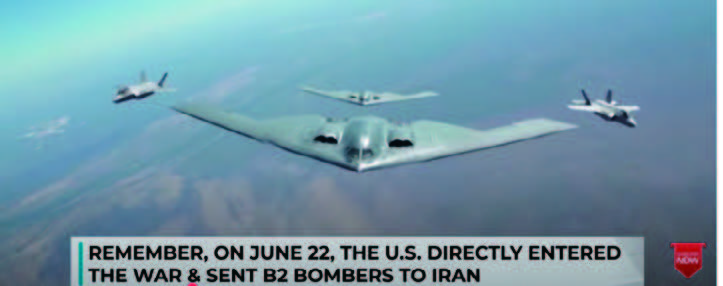
Hindustan Times より From Hindustan Times
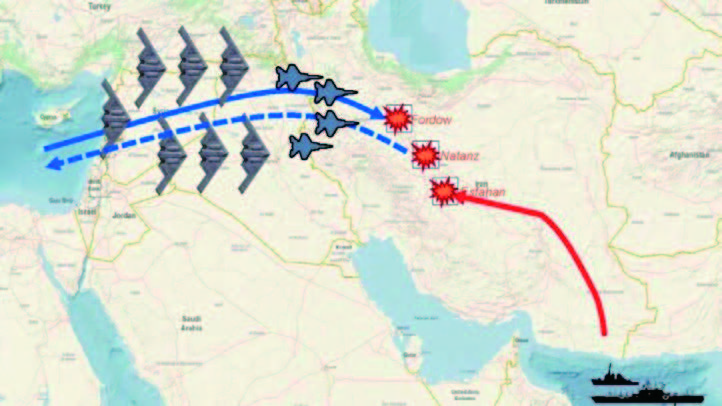
Operation Midnight Hammer, a US Department of Defense airstrike on Iran’ s nuclear facilities, was conducted on June 21, 01:40 – 02:05(21JST 07:40-08:05) Iranian time. (The above image is from Yahoo! JAPAN News/Expert 2025/6/23 (Mon) 03:18)

Exclusive:“ How the Israeli Air Force Eradicated Iran’ s Nuclear Program and Military Power” Screenshot from TBN Israel video
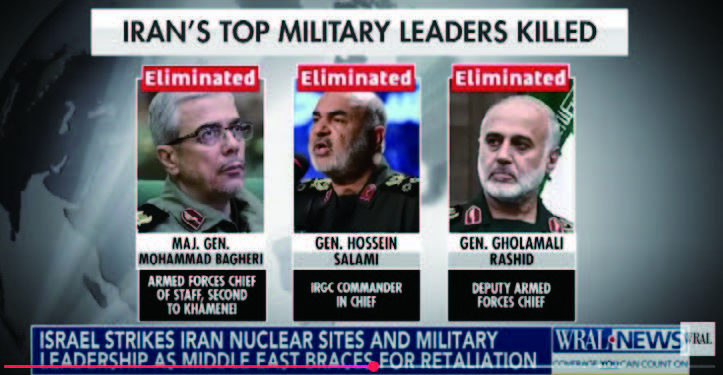
Israel strikes Iran’ s nuclear and military sites, and kills its top generals (By WRAL)
Israeli-Palestinian conflict escalates
In mid-January, armed clashes between Israel and Hamas escalated in Gaza. In response to Hamas rocket attacks, Israeli forces launched large-scale air strikes on bases and other sites, resulting in heavy casualties. Hamas fired hundreds of rockets in retaliation, causing limited damage to Israel. The United Nations and other organizations have called for a ceasefire, but so far the issue of hostages and the presence of Israeli troops in Gaza have hampered efforts to reach a long-term ceasefire.
The Trump administration has reiterated its strong support for Israel, saying that Israel has the right to defend itself. Under the Biden administration, the framework for humanitarian aid to Palestine and the search for a “two-state solution” have been effectively shelved. As a result, Gaza residents are suffering from shortages of food and other goods and are facing a crisis. More than 60,000 people have been killed in Israeli attacks.
Gulf states caught in the middle
Saudi Arabia and the United Arab Emirates (UAE) normalized relations with Israel under the Trump administration’s 2020 Abraham Accords. Concrete results had already begun to emerge, such as economic cooperation and the development of tourism, but the intensification of the conflict in Gaza has significantly changed the situation.
Saudi Arabia in particular, has to take into account public opinion at home and abroad, as it is unable to ignore support for Palestine as it hosts two major Islamic holy sites. At the same time, the country has benefited greatly from economic cooperation and security with Israel, and its foreign policy has faced difficult adjustments.
China’s Rise and Russia’s Retreat
China and Russia have been deeply involved in the region, as well as the United States. China has strengthened economic ties with Iran and Saudi Arabia, and increased infrastructure investment, particularly as part of its Belt and Road Initiative. Russia has also intervened militarily in Syria’s civil war, supported President Bashar al-Assad and maintained a military presence in the Mediterranean. But Russia’s influence in the Middle East has waned due to its war with Ukraine. Turkey-backed Islamists toppled President Bashar al-Assad, forcing Russia to withdraw from Syria.
US Posture at the Crossroads of Domestic and Foreign Affairs
Under the slogan “Make America Great Again (MAGA),” the Trump administration is still emphasizing the “revival of a strong America” to its domestic supporters, including evangelicals. In contrast to the Biden administration, which seemed to be curtailing its involvement in the Middle East on the back of energy independence, the Trump administration is actively using military force and sanctions to reassert US influence. While consolidating its support base in domestic politics, the Trump administration is seeking to bring Saudi Arabia into Abraham Accord, but the Palestinian issue has hampered progress so far.
Outlook
The situation in the Middle East in 2025 was a complex mix of factors, including a flare-up of the Iran nuclear issue, intensified Israeli-Palestinian conflict, and turmoil in the Gulf states. The United States remains the key to stability, and there is no doubt that it will continue to face difficult maneuvers.
At the same time, the weakening of Iran has increased Israel’s influence in the region, and there are rumors of an era of “Israel’s dominance.”
Destabilization in the Middle East will not only affect the global economy through the energy market, but also worsen the humanitarian situation in the region and deepen the division of the international community. The future of the Middle East will be an unavoidable and important issue for global politics and economics.